LIND ID: hochier / WeChat: hochier
(Fine Boring Technical Notes) Solution for Bore Hole Boring on Post-Welding Chassis and Machining
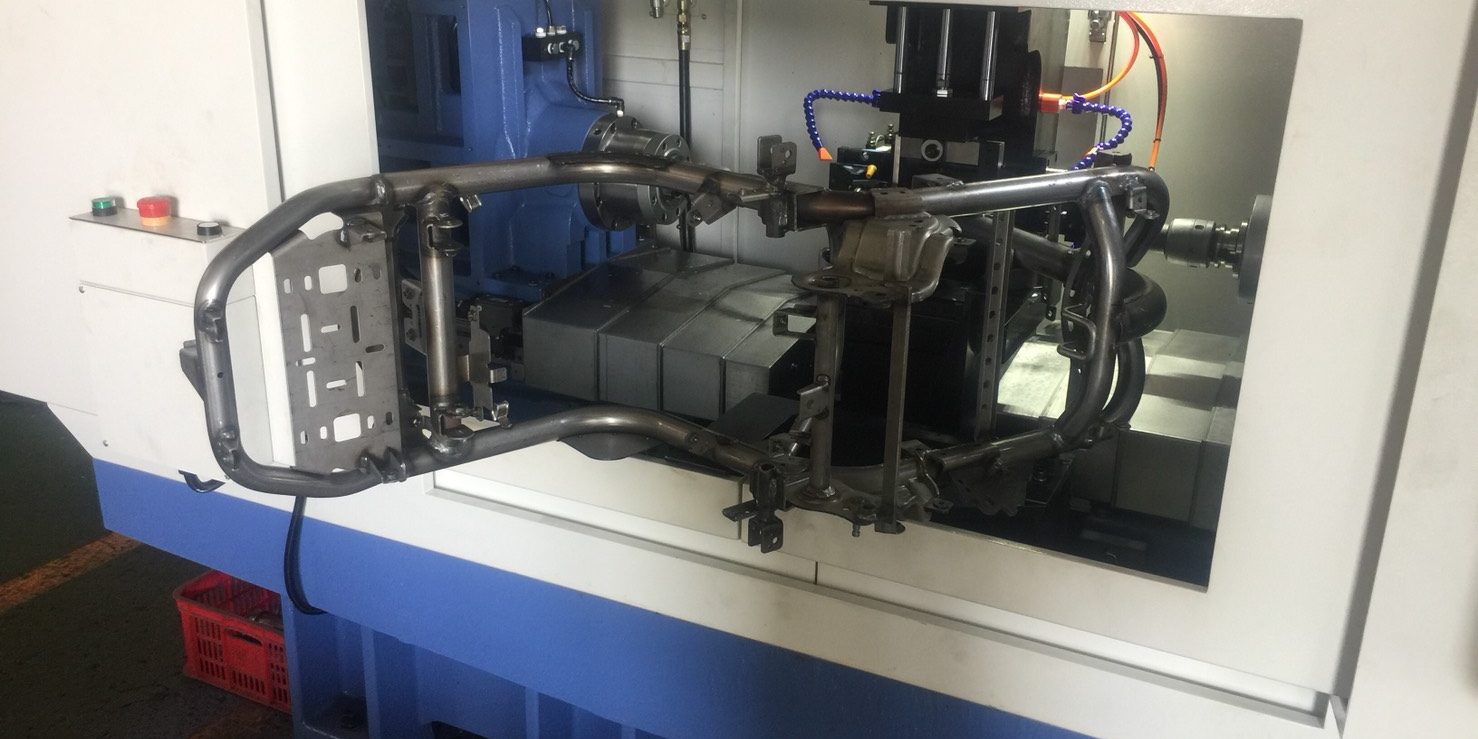
Frame caving
After welding, the frame is drilled. Compared to the current drilling machine used in the automotive and motorcycle industry, which uses partial pipe processing followed by welding and assembly, this method can reduce the risk of the frame deforming after welding and becoming unassembleable.
The upstream manufacturers are constantly demanding higher precision in assembly, which not only carries the risk of a high defect rate but also limits production capacity.
Post-Mechanical We will establish independent innovation and R&D capabilities to develop precision boring machining control technology, whole machine processing mode, alignment technology and key modules to meet the industry's expectations for mass production and high-precision quality.
The purpose and importance of cavitation
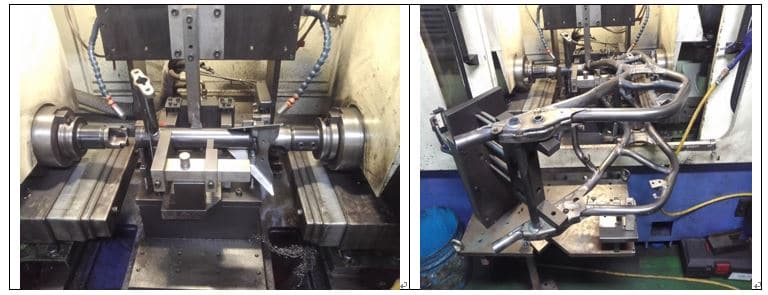
Improve accuracy
To machine the hole to a precise size, boring tools are typically used to cut into an existing hole.
Ensure concentricity
The contact measurement mode helps to confirm the pre-processing settings and processing parameters. If there are any deficiencies, they can be corrected immediately, avoiding the complicated process of re-putting the product after it has been removed from the shelf, thus saving time and labor costs.
Improve surface quality
Boring makes the hole wall surface smoother, which is beneficial for the smooth installation and operation of bearings or related parts.
Solving the deformation problem
It effectively eliminates hole position offset and dimensional errors caused by welding stress.
Institutional innovation
The locomotive frame's overall structural positioning design simplifies the production process, while the flat structure design reduces equipment space utilization.
Improve the control technology of hole boring
Compared to the previous partial part machining, the whole vehicle boring control requires more consideration and design in terms of control process and positioning rules in order to achieve the best quality results during machining.
Fixture design
Customized jigs and fixtures are provided according to the product style. For a single piece, it only needs to be placed and clamped with a simple fixture. For the whole vehicle, different types of clamping fixtures are required depending on the structural complexity of the customer's product to maintain stability and accuracy during the boring process.
Processing equipment and technology
Dual-end synchronous processing
These machines can process holes from both ends of the frame simultaneously, ensuring concentricity of the left and right holes and improving production efficiency.
CNC control
CNC (Computer Numerical Control) technology ensures the precision and repeatability of the machining process, making it particularly suitable for large-scale production of high-standard chassis.
Rough Enameling and Fine Enameling
The processing usually consists of two stages:
Rough Boring:
Quickly remove excess material to determine the preliminary shape and location of the holes.
Fine Boring:
Fine finishing is performed to achieve the final required dimensional accuracy, roundness, and surface finish.
Whole vehicle processing mode
Some models from Housheng Machinery can even be caved directly after the entire chassis is welded to ensure final assembly accuracy.
Application Scope
Motorcycle/bicycle head tube
The location for installing the steering shaft (center bar) bearing.
Rear suspension rocker arm connecting seat
Ensure the installation accuracy of the rear swingarm.
bottom bracket
(Bicycle crankshaft mounting location).
Automobile/locomotive bearing housing or guide bushing.