LIND ID: hochier / WeChat: hochier
Expanding & Shrinking
Pipe expander(Tube Expander / Pipe Expanding Machine), also known as a tube expander or pipe expander, is a specialized machine used to expand tubes into pipes.Enlarged opening diameter of metal or plastic pipesThe equipment is designed to facilitate the connection of two tubes together, or to tightly bond tubes to tube sheets in a heat exchanger.
Pipe expansion principle and types
The working principle of a pipe expander is usually to use mechanical pressure or hydraulic pressure to insert a conical mandrel or a multi-lobed expander head into the inside of the pipe and squeeze the pipe wall outward to make its diameter expand uniformly.
The main types include:
- Manual expander:
- FeaturesSmall in size and lightweight, it is usually equipped with a ratchet mechanism to save physical effort. Suitable for small-scale applications such as on-site repair and air conditioning installation.
- applicationAir conditioning copper pipe installation and plumbing/electrical repair.
- Electric/Lithium-ion Battery Expander:
- FeaturesDriven by batteries or power, it automatically completes tube expansion, saving time and effort and achieving high efficiency.
- applicationProfessional air conditioning installation, batch on-site operations.
- Hydraulic Expanding Machine:
- FeaturesThe hydraulic system provides a powerful and stable expansion force, suitable for large-diameter, thick-walled pipes, and even for the manufacture of boiler-related heat exchangers.
- applicationHeavy industry, boiler manufacturing, and production of large heat exchangers.
- Automatic Double-end Expander:
- FeaturesIndustrial-grade machines can simultaneously perform forming processes such as flaring, shrinking, flanging, punching, or sealing on both ends of pipes. They typically employ servo control to ensure high precision.
- applicationSatellite ear brackets, automotive parts, and automated production lines for mass production of tubing.
Application areas
Pipe expanders are widely used in various industries that require pipe connections:
- Air conditioning and refrigerationThe copper pipe is flared to facilitate the connection of refrigerant lines and reduce the number of welding points.
- Heat exchangers and boilersExpand the heat exchange tubes to the tube sheet to ensure a tight seal.
- Automobile manufacturingEnd forming of exhaust pipes and oil line fittings.
- Furniture manufacturing: Connection and assembly of metal furniture fittings.
- Building and HydropowerConnection of PVC water pipes and metal water pipes.
The following are the various types of tube expanders:


Market Trends in 2026
With the increasing demand for automated production, the market trend for pipe expanders in 2026 emphasizes high efficiency and multi-functional integration. Many devices can not only expand pipes but also shrink them simultaneously, achieving integrated "expansion (shrinkage)" operations. In addition, hand-operated and electric pipe expanders are becoming increasingly popular, improving the convenience of on-site construction.
Hydraulic molding machine
A hydraulic forming machine is a type of machine that utilizes...The hydraulic system generates powerful pressureAn industrial machine is an industrial device that presses materials (such as metal sheets, pipes, rubber, and plastics) into a mold for shaping or setting. These specialized machines play a crucial role in various industries due to their stable pressure and adjustable stroke.
Main features and advantages
- High pressure outputHydraulic systems can provide greater tonnage pressure than mechanical punch presses, making them suitable for handling thicker or harder materials.
- Stable and controllable pressureHydraulic presses provide stable pressure output and are flexible in operation. Pressure, stroke, and speed can all be precisely adjusted, making them suitable for complex molding processes that require fine control.
- Multifunctional integrationMany specialized machines can be used with different molds to achieve a variety of processing functions, such as deep drawing, bending, punching, pressing, forging, and thread rolling.
- Customized designSpecialized machines can be customized to meet specific customer needs, including machine shape (such as C-type, four-column type), table size, and automation system integration.
- Automated compatibilityIt is easy to integrate with automated mechanisms, feeding systems or quick mold change systems to improve production efficiency and reduce manpower burden.
Application areas
Hydraulic forming machines are widely used in various manufacturing industries, especially in applications requiring high precision and complex molding processes.
- MetalworkingUsed for deep drawing of automotive sheet metal, bending and stamping of laptop casings, kitchen utensils, and bicycle parts.
- Rubber and PlasticsUsed for compression molding of rubber and silicone products such as tires, seals, gaskets, bakelite, and melamine.
- Other materialsSuitable for pressing and shaping of composite materials, brake pads and other special industrial products.

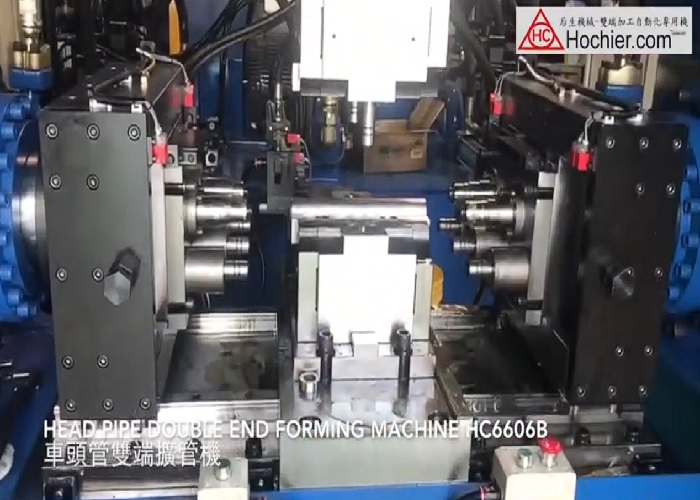
Motorcycle head tube double-end expansion and contraction forming machine | High-precision frame forming equipment | HC6606
Ho Chier's End Forming Machine 6606 is a machine specifically designed for motorcycles…
Two-stage end forming machine | Metal pipe end forming equipment | HC1712 series
The HC1712A HCN.13068 is a two-stage end forming machine manufactured by Housheng Enterprise Co., Ltd.
Heading forming machine | Metal round head forming equipment | HC1604 series
HC1604N HCN.21535 HC1604N is a heading machine (also known as a rounding machine or pipe end forming machine) manufactured by Housheng Enterprise Co., Ltd.
Automotive parts stabilizer bar tube expander | Metal tube end forming equipment | HC6615
TBM HC6615 HCN.21539 Pipe Expander: The TBM HC6615 pipe expander is a dedicated pipe end forming machine…
Double-sided pipe expander | Satellite ear bracket | Hydraulic forming machine HC6621
Double-sided pipe expander HC6621 HCN.15198 The HC6621 double-sided pipe expander is a machine specifically designed for expanding the ends of pipes…
Automotive stabilizer bar tube end forming and thickening machine | Suspension system steel pipe end preforming equipment | HC6616 thickening machine
Automotive stabilizer bar - Pipe end forming and roughening machine HC6616 HCN.20495. Machine features: vertical clamp, horizontal punch, manual feeding, automatic discharge in two stages...